
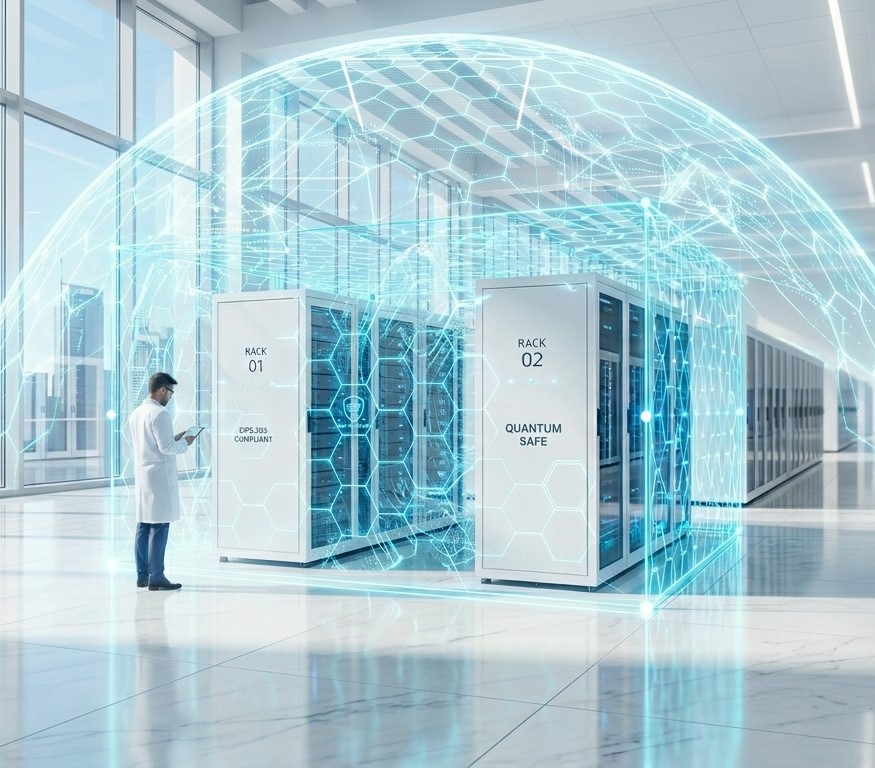

Industry: Financial Services

Communicate urgency and regulatory alignment for US banking institutions

Post-Quantum Resilience for Global Finance.

Securing SWIFT, ATM networks, and core banking ledgers against quantum intercept.
The financial sector is the primary target for quantum encryption threats. We provide specialized PQC for Banks designed to protect high-frequency transaction data and long-term historical records.

FIPS 203/204/205 Readiness.

Legacy systems relying on RSA-2048 are the prime targets for “Harvest Now, Decrypt Later” (SNDL) attacks. Our solution is purpose-built for NIST PQC standards, specifically FIPS 203, 204, and 205. We help banks meet the upcoming 2026 FDIC/OCC compliance mandates by replacing vulnerable protocols with quantum resistant encryption.

Mitigation Outcome

Proactive defense is a financial necessity. With the average financial data breach costing $6.08M, the risk of historical data exposure is an existential threat. Quantum-Safe Migration Services don’t just protect future data; they secure the historical “digital gold” that hackers are harvesting today.

Discover

With our Quantum-Safe platform, we locate critical data segments on your cloud, databases, and secure systems along with their applications, network, web applications, mobile applications, and social handles.

We Identify cryptography usage, inter-dependencies, and generate a Cryptography Inventory of Items (CI3).

Analyze

Powered by our Quantum-Safe technology, we examine, assess, and evaluate your entire cybersecurity infrastructure by performing a detailed risk analysis, simulations & testing.

We Analyze the cryptographic posture of compliance and prioritize vulnerabilities based on risks. Track KPIs for cryptographic modernization.

Transform

We Remediate vulnerabilities and strive to migrate to the most updated NIST standards.

We provide long-term monitoring services using quantum-safe best practices to keep you secure.

We help you learn, explore, and implement quantum-safe cryptography to achieve crypto-agility.

Technical Information

NIST has finalized the following three PQC standards to strengthen modern public-key cryptography infrastructure for the quantum era:


• ML-KEM (derived from CRYSTALS-Kyber) — a key encapsulation mechanism selected for general encryption, such as for accessing secured websites
• ML-DSA (derived from CRYSTALS-Dilithium) — a lattice-based algorithm chosen for general-purpose digital signature protocols
• SLH-DSA (derived from SPHINCS+) — a stateless hash-based digital signature scheme

Post-quantum cryptography centers on encryption protocols whose complexity does not rely on factoring large prime numbers vulnerable to Shor’s algorithm. Key techniques include Lattice-based cryptography hides messages within high-dimensional mathematical structures problematic to decrypt.

Hash-based signatures applying cryptographic hashing functions impractical for quantum systems to invert.

Code-based cryptography embeds data in error-correcting codes unbreakable by known quantum attacks.

Among these approaches, lattice-based and code-based techniques emerge as the most performant and versatile options favored by standards groups. The National Institute of Standards and Technology (NIST) recently selected four encryption algorithms – three lattice-based (CRYSTALS-Kyber, NTRU, and SABER) and one code-based (BIKE) – as the first post-quantum cryptographic standard.