
Abstract
The emergence of quantum computing presents a fundamental challenge to the cryptographic systems that underpin modern financial infrastructure. While much of the discourse has focused on future quantum capabilities, a more immediate and under-recognized threat exists in the form of “Harvest Now, Decrypt Later” (HNDL) attacks.
This article examines the implications of HNDL for financial institutions, highlighting the risks associated with long-lived data, current cryptographic dependencies, and delayed decryption scenarios. It further outlines strategic considerations for mitigating these risks through early adoption of post-quantum cryptographic frameworks and crypto-agile architectures.
1. Introduction
Financial institutions rely extensively on cryptographic systems to ensure confidentiality, integrity, and authenticity across digital operations. These systems are embedded within:
- payment infrastructures
- interbank messaging systems
- digital banking platforms
- data storage and archival systems
Traditional cryptographic schemes such as RSA and Elliptic Curve Cryptography (ECC) are widely considered secure against classical computational attacks. However, advancements in quantum computing introduce the potential to compromise these systems using quantum algorithms, most notably Shor’s algorithm.
While large-scale quantum capabilities remain under development, the risk model must account for adversarial strategies that exploit future decryption capabilities against data collected today.
2. Definition of Harvest Now, Decrypt Later
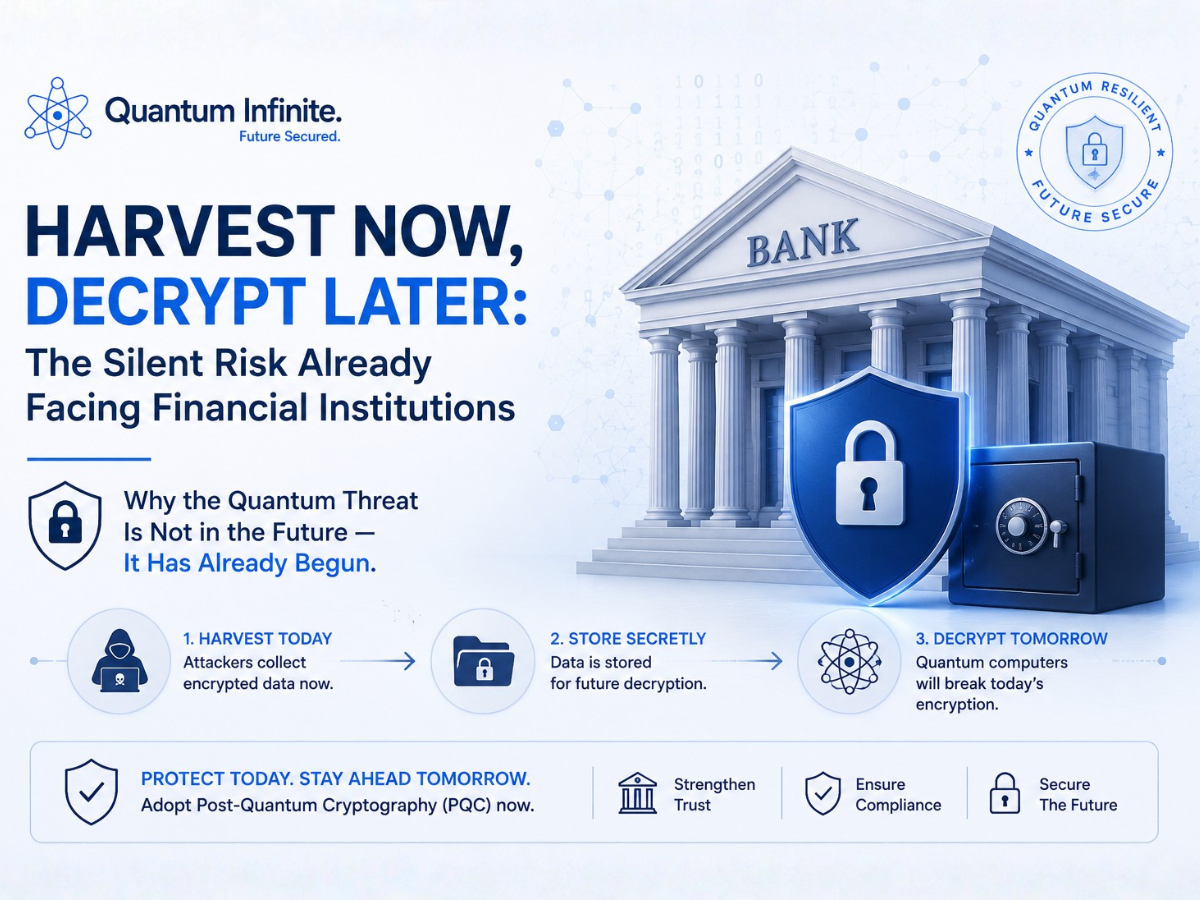
The HNDL paradigm refers to a two-phase attack model:
- Data Harvesting Phase Encrypted data is intercepted and stored without immediate decryption.
- Deferred Decryption Phase Stored data is decrypted at a future point when quantum computational capabilities become sufficient to break the underlying cryptographic schemes.
This model shifts the threat from immediate compromise to delayed exposure, creating a temporal disconnect between data breach and data exploitation.
3. Cryptographic Vulnerability Landscape
3.1 Dependence on Public-Key Cryptography
Financial systems predominantly rely on:
- RSA-based encryption
- ECC-based digital signatures
- Public Key Infrastructure (PKI) systems
These systems depend on mathematical problems that are computationally infeasible for classical systems but are expected to be solvable efficiently by quantum computers.
3.2 Implications of Quantum Algorithms
Shor’s algorithm enables:
- efficient integer factorization
- discrete logarithm computation
This directly undermines RSA and ECC, rendering current cryptographic protections ineffective once sufficiently powerful quantum systems become operational.
4. Financial Sector Exposure
4.1 Long-Term Data Retention
Financial institutions are required to retain sensitive data for extended durations due to:
- regulatory compliance
- audit requirements
- legal obligations
Data retention periods frequently extend beyond 10–30 years, exceeding the projected timeline for quantum cryptographic disruption.
4.2 High-Value Data Assets
The following categories are particularly vulnerable:
- payment transaction records
- SWIFT and interbank communications
- customer identity and KYC data
- financial contracts and credit records
Such data maintains long-term strategic and monetary value, making it attractive for adversarial storage.
4.3 Systemic Interconnectivity
Financial ecosystems are highly interconnected, increasing exposure across:
- correspondent banking networks
- third-party service providers
- fintech integrations
- cloud infrastructure
Each connection introduces additional vectors for data interception.
5. Attack Surface Analysis
5.1 Data-in-Transit
Encrypted communications across:
- TLS sessions
- VPN channels
- payment messaging networks
are susceptible to interception and storage.
5.2 Data-in-Storage
Archived and backup data remains vulnerable if:
- Encryption algorithms are later broken
- Key management systems are compromised
5.3 Third-Party Ecosystems
External vendors and service providers represent indirect entry points for data harvesting activities.
6. Temporal Risk Considerations
The HNDL model introduces a critical timing challenge. If:
- Data must remain secure for 5 or more years
- Quantum decryption becomes viable in the very near future
Then the risk is already active in the present.
This necessitates a shift from reactive to forward-looking security strategies.
7. Impact Assessment
7.1 Confidentiality Breach
Sensitive data may be exposed long after its creation, compromising historical records.
7.2 Regulatory Risk
Delayed breaches may result in:
- Compliance violations
- Legal liabilities
- Reputational damage
7.3 Strategic Exposure
Confidential financial strategies, including trading and M&A activities, may be revealed retrospectively.
7.4 Systemic Trust Implications
Trust in financial systems may be undermined if historical data integrity cannot be guaranteed.
8. Mitigation Strategies
8.1 Post-Quantum Cryptography (PQC)
The adoption of PQC algorithms represents the primary mitigation approach. These algorithms are designed to resist both classical and quantum attacks.
8.2 Cryptographic Discovery
Institutions must identify all cryptographic implementations across their infrastructure.
8.3 Crypto-Agility
Systems should be designed to enable rapid replacement of cryptographic algorithms without extensive architectural changes.
8.4 Prioritization Framework
Focus should be placed on:
- Long-lived data
- High-value systems
- Externally exposed interfaces
8.5 Phased Migration
A hybrid approach combining classical and post-quantum cryptography is recommended during the transition period.
9. Strategic Implications
The HNDL paradigm represents a shift from traditional cybersecurity models focused on immediate threats to a long-horizon risk framework. Financial institutions must evolve from: “Protecting systems in real time” to “Protecting data across decades.”
10. Conclusion
Harvest Now, Decrypt Later is not a theoretical future risk. It is an active and ongoing threat model enabled by current data collection capabilities and future quantum advancements. For financial institutions, the implications are clear:
- Data being encrypted today may not remain secure tomorrow
- Preparation timelines must account for long-term exposure
- Early adoption of quantum-resistant strategies is critical
Final Observation
The most significant breaches of the quantum era may occur years before they are ever detected.