
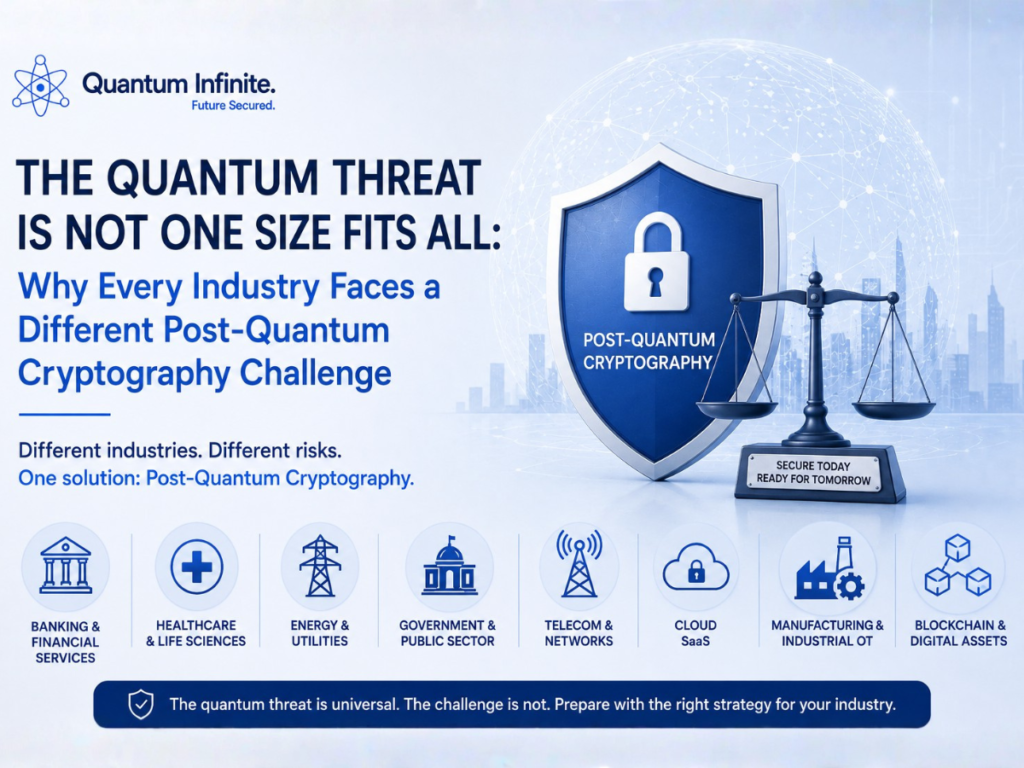
The Quantum Threat Is Not One Size Fits All: Why Every Industry Faces a Different Post-Quantum Cryptography Challenge
When two CISOs compare notes on quantum risk – one running security for a regional bank, the other for a regional hospital – they quickly realize they are not looking at the same problem. The bank CISO is focused on SWIFT transaction authentication, correspondent banking communications, and a G7 mandate that puts critical system migration on a 2030 deadline. The hospital CISO is thinking about patient records that carry a 30-year confidentiality requirement and medical devices with embedded cryptographic firmware that cannot be patched without a hardware replacement.
Both of them are running RSA and ECC. Both of them are in the HNDL collection window. But the migration challenge in front of each is entirely different.
That is the reality of post-quantum cryptography in 2026. The threat is universal – Shor’s algorithm does not care what industry you are in when it factors the RSA key protecting your most sensitive data. But the data longevity, the regulatory mandate, the infrastructure age, and the migration complexity vary dramatically by sector. Understanding where your industry sits in that picture is the first step toward a migration plan that actually works.
Quantum Infinite works with banks, financial institutions, and critical infrastructure operators across these sectors. What follows is what we actually see when we run cryptographic assessments inside these environments – not a generic overview, but a ground-level view of how quantum risk lands differently depending on what you do and how long your data must stay secret.
Why RSA and ECC Are the Common Thread – and Why NIST Has Already Replaced Them
Every sector described below shares the same cryptographic foundation. RSA and Elliptic Curve Cryptography (ECC) secure the authentication handshakes, key exchanges, and digital signatures that protect virtually every digital transaction, communication, and record in the modern economy.
Both depend on mathematical problems – integer factorization for RSA, discrete logarithm on elliptic curves for ECC – that classical computers cannot solve at scale. A large quantum computer running Shor’s algorithm can solve both in polynomial time. That is not a theoretical projection anymore. It is the engineering target that Google, IBM, and others are actively pursuing, with Google’s internal roadmap placing cryptographically relevant capability at 2029.
NIST spent eight years evaluating replacements and finalized three post-quantum cryptography standards on August 13, 2024:
- FIPS 203 – ML-KEM (Module-Lattice-Based Key Encapsulation Mechanism): Replaces RSA and Diffie-Hellman in key exchange. The primary standard for protecting data confidentiality in transit and at rest.
- FIPS 204 – ML-DSA (Module-Lattice-Based Digital Signature Algorithm): Replaces RSA and ECDSA for digital signatures. Protects authentication, non-repudiation, and code signing.
- FIPS 205 – SLH-DSA (Stateless Hash-Based Digital Signature Standard): An alternative signature scheme with different mathematical foundations, providing resilience if lattice-based cryptanalysis advances.
These standards are available now. Deploying them is not waiting for a future technology – it is an implementation project that organizations in every sector below can begin immediately.
In June 2026, the White House issued Executive Order 14412, ‘Securing the Nation Against Advanced Cryptographic Attacks.’
It sets a December 31, 2030 deadline for post-quantum encryption and December 31, 2031 for post-quantum authentication across federal systems – and directs support for critical infrastructure to do the same. The Office of Management and Budget followed with M-26-15 providing the implementation framework. Internationally, ENISA has called for EU member states to begin PQC transition by end of 2026. The UK NCSC has set migration milestones for 2028, 2031, and 2035. The G7 Cyber Expert Group published a coordinated financial sector PQC roadmap in January 2026. The direction from every major regulatory authority is identical: migration must begin now.
Financial Services: The Sector With the Shortest Effective Migration Window
Financial services sits at the intersection of the highest HNDL value and the most complex migration challenge. Banks process trillions in daily transactions across SWIFT, payment rails, core banking platforms, and correspondent banking networks – every one of those channels depends on RSA or ECC key exchange for session security.
The Citi Institute estimated that a single-day quantum attack on a major U.S. bank could create over $3 trillion in GDP exposure, with cascading effects across interconnected financial infrastructure. That figure comes from the structural reality: banks are not isolated systems. They are nodes in a network where one quantum-compromised institution becomes an attack vector against every institution it connects to.
SWIFT, Core Banking, and Payment Rails: Where the RSA Exposure Actually Sits
SWIFT message authentication, ACH and Fedwire transaction signing, digital certificate management for online banking, and TLS for every customer-facing channel all carry RSA or ECC dependencies. When we conduct a cryptographic inventory inside a bank’s infrastructure, we consistently find that the cryptographic footprint is significantly larger than the IT asset register suggests.
Legacy core banking platforms – many running on code bases from the 1990s and 2000s – contain embedded cryptographic library calls that have not been touched since deployment. Third-party payment processors introduce algorithm dependencies the institution does not control. Branch-to-headquarters encrypted links use VPN firmware that requires vendor coordination to update.
The migration complexity is real. But the Harvest Now, Decrypt Later risk is more immediately real. Every encrypted transaction record, authentication credential, and customer communication in transit today is a potential HNDL collection target. The attacker does not need to break RSA today. They need to store the encrypted traffic until 2029.
Why the G7 January 2026 Roadmap Sets the Effective Banking Deadline
The G7 roadmap is not a soft recommendation. It is a coordinated framework from the finance ministers and central bank governors of the world’s largest economies, targeting the specific infrastructure categories – payment systems, central bank connections, systemically important financial institutions – where quantum vulnerability creates systemic risk.
Banks that begin their cryptographic inventory now finish the migration with control and sequencing. Banks that wait until 2028 face a compressed window against a hard deadline, with vendor lead times, regulatory examination pressure, and board reporting requirements all converging simultaneously.
This is the financial sector’s specific urgency: the data being collected today under HNDL attacks
is already inside the G7 migration timeline. The migration must complete before the data becomes readable.
Healthcare: The Longest HNDL Exposure Window in Any Commercial Sector
Patient records are not like financial transaction data. A wire transfer record might need to stay confidential for seven years under regulatory requirements. A patient’s medical history, genomic sequence, and diagnostic records can carry a 30-year or lifetime confidentiality requirement. That is the longest data longevity of any commercial sector – which makes healthcare one of the highest-value HNDL targets for adversaries with long time horizons.
Consider what that means in the Mosca Inequality framework: if a hospital’s patient data must remain confidential for 30 years from today, and a cryptographic migration takes five years to complete, the institution needs to begin before 2026 to ensure that data remains protected when quantum decryption capability arrives. For most healthcare organizations, that window has not just closed – it has passed.
Connected Medical Devices: The Hardcoded Cryptography Problem
The healthcare sector has a migration challenge that no other industry faces at the same scale: medical devices. Pacemakers, insulin pumps, infusion systems, imaging equipment, and diagnostic tools frequently run embedded cryptographic firmware that was never designed to be updated remotely. Many require physical hardware replacement to change the cryptographic implementation.
These devices operate on 7–15 year lifecycle schedules. A hospital that procured infusion pumps in 2022 may still be running those devices in 2031 – with RSA-based authentication intact. When you map the device lifecycle against the quantum timeline, a significant portion of healthcare organizations will still have quantum-vulnerable medical devices in operation when the 2029 threshold arrives, simply because the replacement schedule predates the awareness.
The only answer is to begin the cryptographic inventory now – mapping every device, every embedded firmware version, every communication protocol – so that the procurement cycles can be adjusted to prioritize PQC-capable hardware in the next refresh cycle. Organizations that do not have that inventory by 2027 will not have time to act before the deadline.
HIPAA’s ‘reasonable safeguards’ standard currently does not explicitly mandate PQC. But ‘reasonable’ in 2026 has a different meaning than it did in 2020, now that NIST has published finalized standards and the federal government has issued an executive order. Healthcare CISOs who do not begin their quantum readiness programs now are accumulating regulatory risk alongside operational risk.
Energy and Utilities: Long-Life Infrastructure and the Hardware Replacement Problem
Energy and utility infrastructure has a characteristic that makes post-quantum cryptography migration uniquely difficult: the systems that control physical processes – industrial control systems (ICS) and operational technology (OT) – were designed to run for 20 to 30 years without replacement.
A substation controller installed in 2010 might be scheduled for replacement in 2035. The cryptographic implementation inside that device – often hardcoded in firmware, never designed for remote update – is the implementation it will run for the rest of its operational life unless the hardware is physically replaced. No software patch, no certificate renewal, no protocol update can change the underlying algorithm if the device does not support it.
This creates a structural problem that pure planning cannot solve. An energy utility that begins its cryptographic inventory today may still have quantum-vulnerable OT systems in operation at the 2029 deadline – not because they did not plan, but because the hardware replacement cycle predates the quantum timeline.
ICS and OT Systems: Why a Software Patch Is Not the Answer
In every other sector, post-quantum migration can be approached as a software and protocol update problem. You update the cryptographic library, reissue the certificates, configure the new TLS parameters, and deploy. In OT environments, none of that logic applies.
SCADA systems, remote terminal units (RTUs), programmable logic controllers (PLCs), and industrial network appliances frequently use proprietary firmware with no update path for cryptographic algorithms. Many of these devices authenticate to control systems using protocols that predate modern cryptographic standards entirely.
The implication for energy sector security teams is stark: the cryptographic inventory is not just a software mapping exercise. It is a hardware lifecycle analysis that must be fed directly into procurement planning. Every OT device that cannot be made quantum-resistant through a software update needs to be flagged for physical replacement, with a timeline that accounts for vendor lead times, regulatory approvals, and operational constraints on taking critical infrastructure offline.
Organizations in energy and utilities that are not yet running a PQC-specific OT cryptographic inventory are not just behind on planning – they are accumulating a hardware replacement backlog that gets more expensive and more time-constrained with every quarter they delay.
Government and Defense: The Strictest Deadlines and the Highest HNDL Stakes
Government and defense face a version of the quantum threat that is qualitatively different from every other sector. The adversaries collecting encrypted government communications are not financially motivated criminals who will monetize the data immediately. They are nation-state actors with 10-to-20-year strategic time horizons who have been systematically harvesting encrypted U.S. government and defense communications for years.
The GAO stated in January 2025 that adversaries ‘can already copy protected data and store it for future access’ and that the quantum threat ‘might already be here.’ Executive Order 14412, signed in June 2026, translated that assessment into policy: the U.S. government is treating HNDL as an active threat, not a hypothetical one, and it is mandating migration accordingly.
The Defense Industrial Base: When Federal Deadlines Become Contractor Deadlines
The direct mandates in EO 14412 apply to federal agencies. But the defense industrial base – the contractors, suppliers, and service providers that work on classified and sensitive government programs – does not get to ignore those deadlines because they are not technically federal agencies.
Federal Acquisition Regulation updates routinely pull contractor cybersecurity requirements into procurement contracts. Organizations that provide services to defense, intelligence, or federal civilian agencies should expect PQC compliance requirements to appear in contract language within the EO 14412 implementation timeline. Those that begin preparing now will be able to demonstrate compliance. Those that do not will face contract risk.
Classified communications represent the highest HNDL priority in any sector. Foreign intelligence services have been collecting encrypted U.S. government and defense communications for years specifically because the long-term value of that intelligence justifies the storage cost. The message from Washington – captured in EO 14412, NSM-10, and OMB M-26-15 – is that migration is no longer optional. It is a national security imperative with hard deadlines.
Cloud Computing and Technology: The PKI Coordination Problem
The technology sector faces a quantum migration challenge that is less about data longevity and more about coordination scale. Public Key Infrastructure (PKI) is the trust foundation of the entire internet – every HTTPS connection, every code signature, every API authentication token, every cloud service credential depends on certificate authorities that issue RSA or ECC certificates.
Migrating PKI to post-quantum standards is not a single organization’s decision. It requires coordinated action across certificate authorities, browser vendors, operating systems, cloud platforms, SaaS applications, hardware security modules, and end-user devices – simultaneously. If a certificate authority updates to ML-DSA but a browser vendor has not deployed the corresponding root update, the trust chain breaks. If a cloud platform updates its API authentication but a customer’s client library has not been updated, the integration fails.
The major technology providers are already moving. Apple integrated post-quantum cryptography into iMessage with the PQ3 protocol, combining ML-KEM with Curve25519 in a hybrid scheme. Google deployed FIDO2 with PQC support for account authentication. Cloudflare has been running hybrid TLS deployments since 2022, and AWS has published its PQC roadmap across its key management and certificate services.
For technology companies, the question is not whether post-quantum cryptography is coming to your environment – it is whether you will lead that transition or scramble to catch up when your dependencies update ahead of your own systems. The organizations that are already mapping their cryptographic dependencies across their full stack are the ones who will complete this migration with operational continuity.
Telecommunications: 5G Authentication, Firmware Signing, and the 6G Design Moment
Telecommunications carries one of the most complex post-quantum migration challenges in the private sector, for two reasons. First, 5G network authentication is built on elliptic curve cryptography – the subscriber authentication protocols, the device identity certificates, the firmware signing chains that secure network equipment, all use ECC in one form or another. Migrating those protocols requires coordinated updates across device manufacturers, chip vendors, network equipment providers, and standards bodies that do not move quickly.
Second, the firmware that secures network equipment – routers, base stations, core network appliances – follows update cycles that more closely resemble OT infrastructure than enterprise software. Major network equipment updates are planned years in advance, tested extensively, and rolled out with extreme caution to avoid service disruption. That conservatism is appropriate for production network infrastructure. But it means the window to begin planning PQC firmware updates is now, not when the algorithms are deprecated.
The 6G Design Opportunity: Building PQC In From the Start
5G deployed at scale before post-quantum standards existed. The migration path for 5G is retrofitting PQC into protocols that were designed around ECC. It is possible, but it is complicated.
6G is still in the design and standardization phase. 3GPP and ITU-R working groups are actively developing 6G specifications now. This is the rare opportunity to build PQC into the protocol from the beginning rather than retrofit it afterward. Telecommunications operators and equipment vendors that are not actively engaged in 6G PQC standardization discussions today are ceding that design influence to competitors who are.
The difference between ‘PQC designed in at the protocol level’ and ‘PQC retrofitted after deployment’ is measured in years of migration effort and hundreds of millions in implementation cost. Telecom organizations that engage now shape the standard. Those that engage later comply with it.
Blockchain and Cryptocurrency: The Irreversibility Problem No Other Industry Faces
Every other sector covered here shares one characteristic: if your encrypted data is stolen, or your authentication is compromised, there are remediation options. You can reset credentials, notify affected customers, reissue certificates, patch the vulnerability, and rebuild. The damage is painful but bounded.
Blockchain removes that option entirely.
On-chain assets are public and immutable. Once a quantum computer derives the private key behind an exposed public key – and uses it to drain a wallet or forge a transaction signature – that transaction cannot be reversed. There is no fraud department. There is no chargeback. There is no incident response playbook that recovers the funds.
Bitcoin’s Exposed UTXOs: The Quantum Countdown Already Running On-Chain
Bitcoin’s quantum vulnerability is not theoretical. The exposed UTXOs are visible to anyone who looks. The question is not whether a quantum attack on exposed Bitcoin addresses is technically possible – it is whether it happens before Bitcoin’s governance process can coordinate a migration to post-quantum signature schemes.
Bitcoin’s governance is decentralized by design. There is no authority that can mandate a migration deadline. Changing the signature scheme requires a consensus mechanism across thousands of nodes, miners, exchanges, wallet providers, and users who do not necessarily share the same view of urgency. The P2SH migration took years to achieve widespread adoption. A PQC migration is a more fundamental change.
The Bitcoin Improvement Proposal (BIP) process for introducing PQC signatures is active, but the timeline from proposal to activation to adoption is measured in years. Organizations holding significant Bitcoin reserves – corporate treasuries, exchanges, custodians – that have not modeled their specific exposure should do so now.
Ethereum’s Active PQC Migration: How Decentralized Governance Moves
Ethereum is further along than Bitcoin in its PQC migration planning. Ethereum Improvement Proposals (EIPs) focused on post-quantum account abstraction and quantum-resistant signature schemes are actively under development, with the Ethereum Foundation explicitly flagging quantum resistance as a long-term protocol goal.
The broader DeFi and smart contract ecosystem sits on the same elliptic curve signatures. Every smart contract that uses ECDSA for authorization, every DeFi protocol that depends on wallet signatures for transaction validation, every NFT that uses digital signatures for provenance – all of these carry quantum vulnerability through the underlying signature scheme.
The difference between blockchain and every other sector is that in blockchain, the attack surface is public, the assets are irreversible, and the governance mechanism for migration is slower than any regulated industry’s compliance process. That combination makes early preparation not just important but uniquely urgent.
The Three Steps Every Sector Must Execute Before 2029
The industry-specific details above shape the migration approach – but the starting point is the same for every organization in every sector. Before any migration can be planned, sequenced, or executed, you need to know what you are actually working with.
Step 1 – Discover: Build a Complete Cryptographic Inventory
A cryptographic inventory maps every algorithm, certificate, protocol, library, key, and embedded dependency across your entire environment – applications, servers, databases, network appliances, cloud platforms, third-party integrations, and vendor-supplied hardware.
Most organizations significantly underestimate the scale of their cryptographic footprint. Legacy applications use libraries that have not been audited in years. Third-party APIs introduce algorithm choices the organization did not make and cannot control. Medical devices, OT systems, and network appliances carry firmware-level cryptographic implementations that do not appear in any software asset register.
Without this inventory, migration planning is guesswork. You cannot prioritize what you cannot see. You cannot negotiate vendor PQC roadmaps without knowing which vendors’ cryptographic choices affect you. You cannot assess your HNDL exposure without knowing which of your systems encrypt the most sensitive long-lived data.
The cryptographic inventory is not a one-time scan. It is the foundation of an ongoing cryptographic management program that allows your organization to track progress, identify new dependencies as systems change, and demonstrate compliance to regulators and auditors.
Step 2 – Analyze: Map Exposure to Your Industry’s Data Longevity
Once you have the inventory, the analysis maps cryptographic controls to the data they protect – and specifically to how long that data must remain confidential.
A system protecting transaction data with a 90-day retention period has a fundamentally different risk profile than a system protecting customer identity records with a 10-year retention period. Both are encrypted. Only one represents a material HNDL target. The risk analysis connects the cryptographic inventory to the data classification framework to produce a prioritized migration sequence based on actual business impact.
The analysis also maps your regulatory exposure by sector: which systems fall under the EO 14412 timeline, which fall under the G7 financial sector roadmap, which fall under HIPAA modernization pressure, which fall under NSA CNSA 2.0. Different systems may be subject to different deadlines, and the migration sequence should reflect those priorities.
Step 3 – Transform: Implement NIST FIPS 203, 204, and 205 with Crypto-Agility Built In
The transformation phase implements NIST-approved post-quantum standards across the prioritized systems identified in the analysis. This is not a flag-day migration where everything changes at once. It is a phased implementation that moves the highest-risk systems first, validates interoperability and performance at each stage, and maintains operational continuity throughout.
Crypto-agility is not a feature to add on top of the migration – it is an architectural principle that should be embedded into every implementation decision. The NIST PQC standards finalized in 2024 will not be the last word on post-quantum cryptography. Cryptanalysis continues. Standards evolve. NIST has already selected HQC as a fourth PQC algorithm to provide backup key encapsulation if ML-KEM faces future cryptanalytic pressure.
An organization with a crypto-agile architecture can respond to future standard changes without redesigning the systems that depend on cryptographic services. An organization that hard-codes algorithm choices into infrastructure faces another migration cycle every time standards change.
How Quantum Infinite Helps Every Sector Migrate – Without Moving a Byte of Data
Most PQC assessment and migration vendors require you to transfer cryptographic configuration data or system information to an external platform during the assessment process. That transfer is itself a new exposure window – created in the process of evaluating an existing one.
Quantum Infinite’s approach is different at the architectural level.
Our entire assessment and migration process operates on-premises, within your controlled environment. Data sovereignty remains 100% with your organization – not as a policy promise, but as the operational architecture of how we work.
Across every sector covered above, Quantum Infinite conducts:
- On-premises cryptographic discovery across web servers, APIs, application code, databases, network infrastructure, and digital certificates
- Cryptographic Bill of Materials (CBOM) development – a complete, structured map of every algorithm, key, certificate, and protocol dependency in your environment
- HNDL exposure analysis – identifying which encrypted data and communications carry the highest longevity risk given your sector’s specific confidentiality requirements
- Sensitive-data longevity assessment – connecting cryptographic controls to the data classification and retention framework your sector requires
- Quantum-vulnerable algorithm and protocol identification including embedded firmware, third-party library dependencies, and vendor appliance configurations
- Vendor and third-party dependency mapping – identifying which external systems require PQC roadmaps before your migration can complete
- Risk-based migration prioritization – sequencing your transition by data longevity, regulatory deadline, business criticality, and infrastructure complexity
- PQC roadmap development aligned with NIST FIPS 203, 204, and 205 and the applicable sector-specific mandates
- Proof-of-concept validation before enterprise-wide deployment – confirming interoperability, performance, and certificate management before any system goes live
Quantum Infinite is a trusted advisor and a member of the Texas Bankers Association. Our work is aligned with NIST FIPS 203, 204, and 205 – and with EO 14412, NSM-10, and OMB M-26-15.
Frequently Asked Questions
Q. Which industry faces the most urgent quantum threat?
Ans. Government and defense face the most immediate regulatory deadline – NSA CNSA 2.0 requires national security systems to be PQC-compliant by 2027. Financial services follows closely with the G7 roadmap targeting critical systems by 2030–2032. But from a data exposure standpoint, healthcare carries the longest HNDL risk window because patient records and genomic data must remain confidential for decades – meaning data collected under HNDL attacks today remains a high-value target well past any Q-Day estimate.
Q. What is the difference between quantum-safe and post-quantum cryptography?
Ans. The terms are used interchangeably in most contexts. Post-quantum cryptography (PQC) refers specifically to classical cryptographic algorithms that are mathematically resistant to quantum attacks – the NIST FIPS 203, 204, and 205 standards fall into this category. ‘Quantum-safe’ is a broader descriptor applied to any cryptographic approach resistant to quantum attacks, which includes both PQC algorithms and quantum key distribution (QKD). For most enterprise applications, PQC is the practical path because it runs on existing infrastructure without requiring quantum hardware.
Q. Do NIST PQC standards apply to private sector companies, not just federal agencies?
Ans. NIST standards are not automatically mandatory for private sector organizations, but they carry significant regulatory weight. Federal contractors are subject to NIST compliance requirements through FISMA and CMMC frameworks. Financial institutions follow NIST guidance embedded in federal banking regulator examination frameworks. Healthcare organizations look to NIST publications in interpreting HIPAA requirements. Beyond compliance, NIST PQC standards are the recognized global benchmark – implementing them is the only way to demonstrate credible quantum readiness to auditors, customers, and regulators.
Q. What is the most urgent single action any organization should take right now?
Begin a cryptographic inventory. You cannot migrate what you cannot see, and you cannot prioritize your migration without knowing which of your systems protect data with the longest confidentiality requirements. The cryptographic inventory is the foundation of every migration plan. Organizations that have a complete inventory in hand by early 2027 will have time to plan and execute a controlled migration. Organizations that do not will be responding reactively to regulatory pressure, vendor deprecations, and Q-Day timelines converging simultaneously.
Q. What should a non-technical executive understand about quantum risk?
Ans. Quantum risk is not primarily a technology problem – it is a data governance and business continuity problem. The relevant question is not ‘how does quantum computing work?’ It is ‘how long must our most sensitive data remain confidential, and will the encryption protecting it today still be secure at that future date?’ For any organization whose answer to that second question involves a timeline beyond 2029, the migration needs to be in active planning now. The window between ‘begin migration’ and ‘migration complete’ is measured in years, not months.
The Window Is the Same for Every Industry. The Migration Is Not.
Ans. Every sector described above faces the same quantum decryption window – 2029, based on Google’s roadmap. But the migration from here to there looks completely different depending on whether you are a bank working against a G7 mandate, a hospital managing 30-year patient records and hardcoded medical device firmware, an energy operator with OT systems that cannot be patched, a government contractor under CNSA 2.0 compliance pressure, or a DeFi protocol whose on-chain assets cannot be recovered if a quantum attack lands before migration completes.
The urgency is identical. The approach is not. That is exactly why a generic migration checklist does not serve most organizations – and why the starting point is always a cryptographic inventory specific to your environment, your data, and your sector’s regulatory framework.
Quantum Infinite
conducts on-premises cryptographic discovery, HNDL exposure analysis, and NIST FIPS 203/204/205 aligned migration across financial services, healthcare, energy, government, and critical infrastructure – without moving a single byte of your data outside your controlled environment.
Book a Quantum Risk Audit
Find out where your organization’s quantum exposure sits today – specific to your industry, your infrastructure, and your data longevity requirements.
Contact Quantum Infinite: Christine@Quantum-Infinite.com