
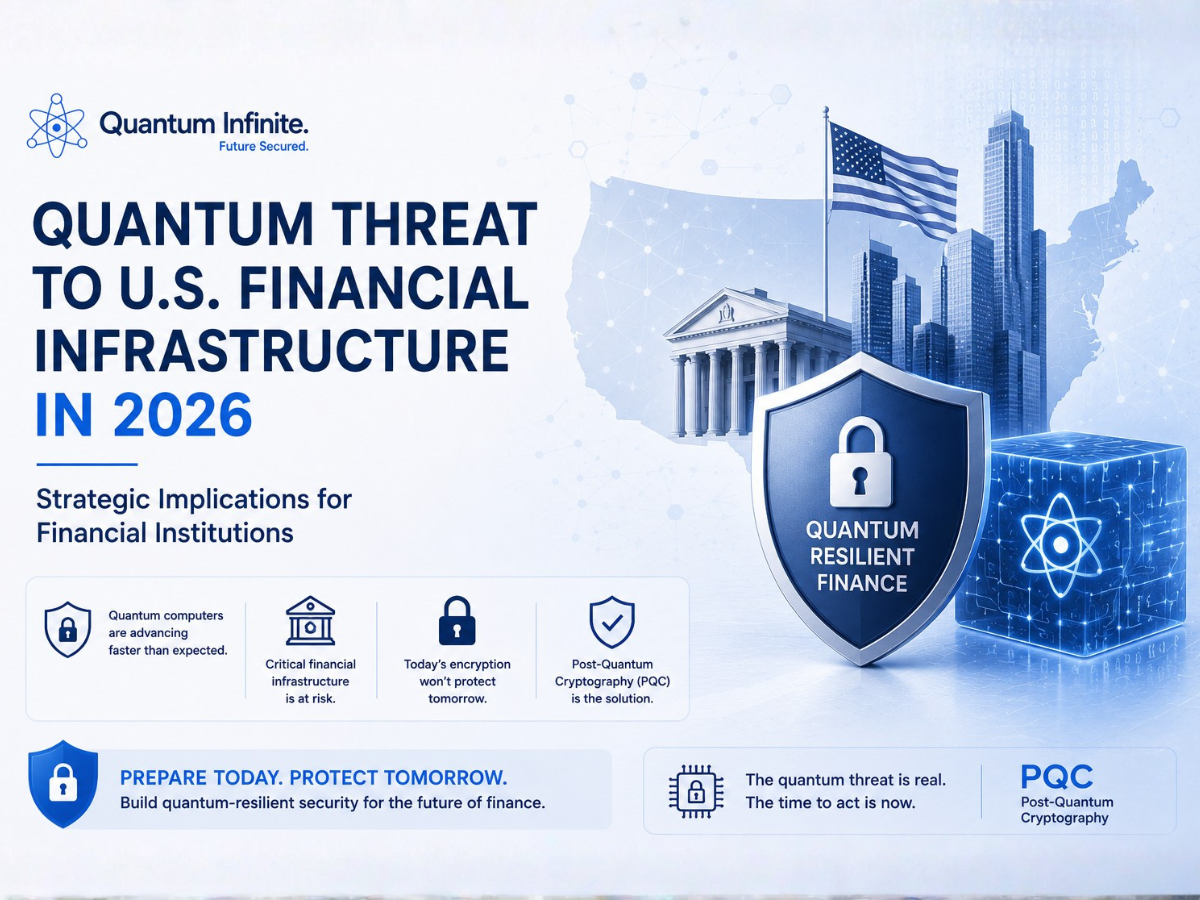
Quantum computing won’t just change technology. It will change the security architecture of global finance.
Why Financial Institutions Must Prepare for the Post-Quantum Security Transition
The global financial system runs on encryption. Every payment, wire transfer, online banking login, and digital asset transaction relies on cryptographic systems that quietly protect the integrity of financial infrastructure. For decades, these systems have worked remarkably well. But a technological shift is emerging that could fundamentally challenge this foundation.
Quantum computing has the potential to break many of the cryptographic algorithms that currently secure the world’s financial systems.
While large-scale quantum computers capable of doing this may still be years away, the transition to quantum-resistant security has already begun. In 2024, the National Institute of Standards and Technology (NIST) finalized the first Post-Quantum Cryptography (PQC) standards, formally beginning a global migration toward quantum-safe encryption. For the United States financial ecosystem, the implications are significant.
Critical infrastructure potentially affected includes:
- Payment networks
- SWIFT messaging systems
- Digital banking platforms
- Blockchain custody systems
Preparing for this transition will become one of the most important cybersecurity challenges facing financial institutions over the next decade.
Why Quantum Computing Changes Financial Security
Most modern encryption is built on mathematical problems that are extremely difficult for traditional computers to solve.
Examples include:
- factoring very large numbers
- solving discrete logarithm problems
These problems form the basis of widely used cryptographic systems such as RSA and Elliptic Curve Cryptography (ECC). However, a sufficiently powerful quantum computer running Shor’s algorithm could solve these problems dramatically faster than classical computers. If that capability emerges, many of the encryption methods protecting financial systems today could become vulnerable. This does not mean the financial system will suddenly collapse. But it does mean that the cryptographic foundations of financial security must evolve.
The “Harvest Now, Decrypt Later” Risk
One of the most concerning quantum-related risks is already occurring today. Cyber adversaries can capture encrypted data now and store it until quantum computers become powerful enough to decrypt it. This strategy is known as:
Harvest Now, Decrypt Later.
For financial institutions, this risk is particularly significant because sensitive financial data often needs to remain secure for decades.
Examples include:
- payment transaction records
- customer identity information
- financial communications
- interbank settlement instructions
If this data is intercepted today and decrypted in the future, confidentiality could be compromised long after the original transaction occurred.
Impact on Payment Infrastructure
The U.S. financial system processes trillions of dollars in payment activity every day across multiple networks and platforms. These systems rely heavily on cryptographic authentication and encrypted communications. Quantum computing could affect payment infrastructure in several ways.
Transaction Authentication
Digital signatures ensure that payment instructions originate from legitimate sources. If these cryptographic signatures become vulnerable, attackers could potentially impersonate institutions or authorize fraudulent transactions.
Secure Communication Channels
Payment systems rely on encrypted communication protocols to secure connections between:
- payment terminals
- issuing banks
- payment processors
- settlement networks
If these encryption mechanisms are compromised, payment messages could potentially be intercepted or manipulated.
Real-Time Payments
As instant payment networks expand, transactions settle within seconds. While this improves efficiency, it also means that security failures could propagate rapidly through the financial system.
Impact on SWIFT and Cross-Border Payments
The SWIFT network connects more than 11,000 financial institutions globally and facilitates secure cross-border payment messaging.
SWIFT messaging security relies on:
- public key infrastructure (PKI)
- digital certificates
- encrypted communications
Quantum computing could challenge these systems if classical cryptographic algorithms are broken.
Potential risks include:
- forged payment messages
- compromised certificate infrastructures
- impersonation of financial institutions
Recognizing this emerging threat, SWIFT and financial institutions worldwide are already exploring quantum-safe cryptographic approaches.
Impact on Digital Banking Platforms
Banking has become increasingly digital. Mobile apps, APIs, and open banking ecosystems rely heavily on encryption to protect customer interactions and financial data. Quantum computing could affect several elements of digital banking infrastructure.
Customer Authentication
Cryptographic authentication systems ensure that only authorized users can access banking platforms. If these systems become vulnerable, attackers could potentially bypass authentication protections.
API Ecosystems
Banks increasingly rely on secure APIs to connect with fintech partners. Quantum vulnerabilities could introduce new risks to these interconnected ecosystems.
Long-Term Data Security
Financial institutions store highly sensitive data that must remain secure for many years. Quantum decryption capabilities could expose historical data if encryption standards are not upgraded.
Impact on Blockchain Custody and Digital Assets
Blockchain technology is also deeply dependent on cryptography. Public blockchains such as Bitcoin and Ethereum rely on elliptic curve cryptography to secure transactions and control digital asset ownership. Quantum computing could eventually challenge this model.
Private Key Exposure
If quantum computers become capable of deriving private keys from public keys, attackers could potentially gain control of blockchain wallets.
Institutional Custody Risk
Financial institutions increasingly offer services such as:
- cryptocurrency custody
- tokenized assets
- digital securities platforms
These systems will eventually need to adopt quantum-resistant cryptographic frameworks.
The Transition to Post-Quantum Cryptography
Recognizing the emerging threat, governments and standards bodies have already started the transition toward quantum-safe encryption. The NIST Post-Quantum Cryptography standards finalized in 2024 provide the foundation for this migration. However, upgrading financial infrastructure will not happen overnight.
Many banking systems rely on legacy technologies embedded deeply within:
- core banking platforms
- payment networks
- certificate infrastructures
- long-term data storage systems
Because of this complexity, the transition to post-quantum cryptography is expected to take a decade or more.
Strategic Priorities for Financial Institutions
Financial organizations should begin preparing now. Key priorities include:
Cryptographic Discovery
Identify where cryptography is used across systems and infrastructure.
Risk Assessment
Determine which systems are most vulnerable to quantum threats.
Crypto-Agility
Design systems that allow cryptographic algorithms to be replaced without major infrastructure changes.
Migration Planning
Develop phased migration strategies toward quantum-safe cryptography.
The Road Ahead
Quantum computing represents one of the most significant long-term cybersecurity challenges facing the global financial system. The transition to post-quantum cryptography will reshape how financial infrastructure is secured. Payment systems, digital banking platforms, cross-border messaging networks, and digital asset custody platforms will all need to evolve. For financial institutions, the question is no longer whether this transition will occur.
The real question is whether organizations begin preparing early enough to manage it safely. The institutions that start preparing today will be the ones best positioned to protect trust, stability, and security in the quantum era.